


The year is 3000. Cars are obsolete; zero-emission, self-driving pods have long since become the standard means of transportation. Such a world is no longer merely an object of science fiction, but a feasible reality in the not-so-distant future. Decades since the invention of cars, they have already evolved from primitive chunks of metal to computers on wheels. However, the convenience they bring comes with significant risks, and although the Terminator may be an extreme scenario, it is certainly reasonable to be cautious of the advancements of technology.
What is an Electric Car?
The electric car (EV) is a relatively new concept in the world of the automotive industry. Although some companies have based their entire model of cars around being proactive and using electricity, some also offer hybrid vehicles that work off both electricity and gas.
An electric car such as Nissan Leaf, Ford Focus Electric or Tesla Model S, Chevrolet Volt is a great way for you to not only save money but also help contribute towards a healthy and stable environment.
ELECTRIC VEHICLE VS FUEL VEHICLE: WHICH ONE IS BETTER TO GO WITH?
Electric cars are entirely charged by the electricity you provide, meaning you don’t need to buy any gas ever again. These vehicles are more convenient, save money, have no emissions, are safe to drive, cost-effective, Low-maintenance charges.
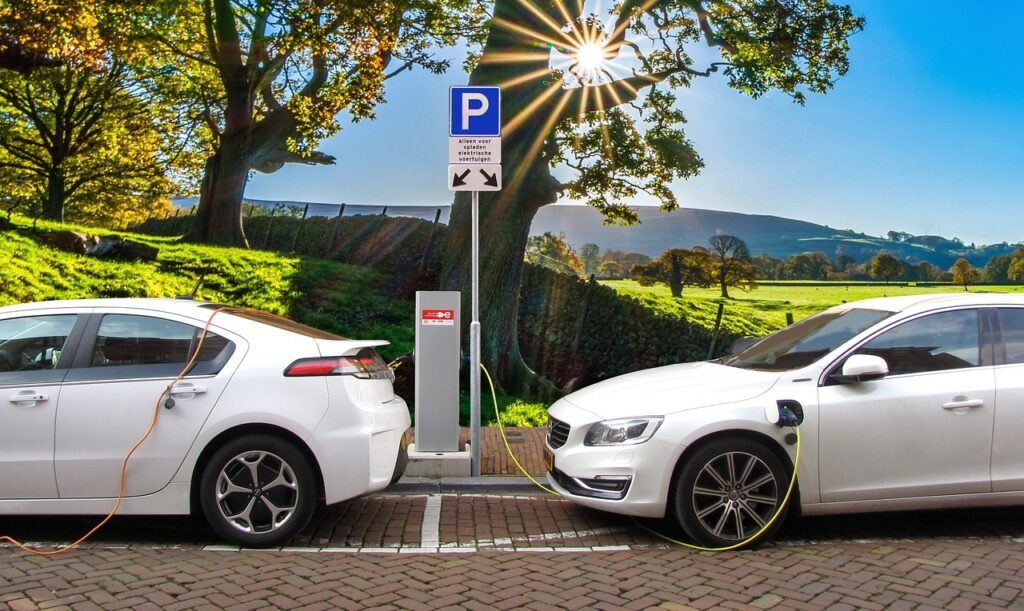
Whereas, the fuel vehicle emits harmful gases like carbon due to petrol or diesel. But, electric vehicles produce fewer greenhouse gases and air pollution than petrol…. As per the research by The European Energy Agency, the carbon emissions of an electric car are around 17-30 % lower than driving a petrol or diesel car.
The Impacts of Electrical Vehicles to the environment: An analysis for future vehicle adoption
Electric vehicle technology has been identified as being a key technology in reducing future emissions and energy consumption in the mobility sector. The nineties have brought us to an era of environmental crisis. We are faced with problems of air pollution, both indoor and outdoor, acid rain, water pollution, hazardous wastes, toxic landfills and leaking storage tanks in our soil, to name a few. Our rapid advances into the industrial and technological age have contributed to these problems. However, engineering tools have been analyzed and verified in providing significant contributions in terms of environmental clean-up and a healthier world.
Environmental impact: –
Diesel fuelled engines produce more CO2 per gallon of fuel combustion with additional release of harmful emissions such as NOx and PM. One diesel vehicle causes pollution equivalent to 24 petrol vehicles or 40 CNG vehicles.
What effect do petrol and diesel engines have on the environment?
Environment – Emissions from diesel engines contribute to the production of ground-level ozone which damages crops, trees and other vegetation. Also produced is acid rain, which affects soil, lakes and streams and enters the human food chain via water, produces meat and fish.
Are petrol cars bad for the environment?
Climate change is one of the greatest environmental threats facing the world today. The carbon dioxide (CO2) found in the exhaust gas produced by petrol and diesel engines is not directly harmful to human health but is the most significant of the greenhouse gases contributing to Climate Change.
Are electric cars better for the environment?
The major benefit of electric cars is the contribution that they can make towards improving air quality in towns and cities. With no tailpipe, pure electric cars produce no carbon dioxide emissions when driving. This reduces air pollution con
Is an electric car cheaper to run than a petrol car?
Electric cars are much cheaper to run based on fuel costs alone. And when you factor in maintenance costs, electric starts looking like an even more attractive option – brake systems tend to last longer than on conventional vehicles, and electric vehicles (EVs) have fewer fluids to change, and far fewer moving parts considerably.
The Rise of Tesla Motors: Renaissance in Transport Industry
The car market has been run by companies such as Volkswagen, Toyota, Ford, BMW, and many other companies, but one of the newer, up and coming companies in this market are Tesla Motors Inc. Tesla has been around for a little over 10 years, and have come quite a long way from where they began. Tesla now sells luxury electric vehicles different from any other electric vehicles today, and they have big plans for expansion in the future. Tesla may not be one of the biggest car companies today, but one day they will be considered alongside companies such as Toyota and Ford. Tesla is one of the newest car companies around, but they have had a long road to where they are today. Martin Eberhard and Marc Trepanning founded Tesla Motors in July 2003…
The most popular car Tesla has released is the Model S, which is a luxury electric sedan that sells for $70,000. The Model S was voted the Motor Trend Car of 2013, and according to Tesla is one of the safest cars ever, but there is one big difference from any other electric car. The battery in each Tesla car is actually made up of thousands of lithium-ion cells, which is
different from most electric vehicles. Electricity charges a battery to give the Model S power for a certain period of time and is similar to a laptop or smartphone. In fact, the company uses lithium-ion batteries just like the type that powers laptops worldwide. This is the key difference between a Tesla electric car and a hybrid, it is all-electric and has to be charged, but a car such as a Prius runs partially on gasoline but does not have to be charged.
Elon Musk’s Electric Future:
Elon Musk plans to ride out the electric car wave at Tesla. Elon Musk isn’t going anywhere.
“If I’m not dead, I’ll be at Tesla,” Musk said during the 2015 Automotive News World Congress in Detroit. The champion of electric vehicles, Musk plans to stay at as long as he’s alive and, he plans to remain CEO until his mission is complete: to see the mass production of electric cars.
“My goal is the acceleration of the advent of electric cars,” Musk said.
Since Elon Musk broke onto the scene in 2008 with the electric Roadster sports car, he has done just that. Demand, though, as far as Tesla goes, is not a problem.
“Most of our focus is on production growth as opposed to demand generation,” Musk said.
That’s because the company has already has sold out of all of the Model S cars it could “possibly make” in 2015, Musk said.
Thanks to this demand, Tesla has been able to invest heavily in automation, the Model X product line, the Supercharger network and in scaling up production.
“We’re spending a lot of money,” Musk said. “But if we were to just sort of scale back our growth and just go forward with moderate increases…we would be profitable.”
List of countries with the highest share of plug-in electric vehicles in new passenger car sales in 2020:
• Norway (74.8%)
• Iceland (45%)
• Sweden (32.2%)
• Netherlands (24.9%)
• Finland (18.1%)
• Denmark (16.4%)
• Switzerland (14.3%)
• Portugal (13.5%)
India in the field of electric cars:
India is making a big push for electric cars. The reason behind this is the cost of petrol, diesel and air pollution. Many people think that electric vehicles are far better than Petrol and diesel vehicles.
The Government of India has decided to make the country a 70% electric cars nation by 2030. Thus, the adoption of electric vehicles will not only reduce import dependence but will also improve local air quality. Adopting an electric vehicle will prove to be an important and ambitious step.
Therefore, it is necessary that proper policymaking should be given prominence in this direction, and work in the right direction should be taken forward so that electric cars can be used by the common people.
Holistic Approach:
Electric cars are the call of the hour. It is because of the consequences of fuel cars on nature. However, it might take time for electric vehicles to become more common so that recharging and maintenance issues would be solved. Electric cars are severely limited by several drawbacks, including A shortage of charging stations. High electricity costs. Disappointing battery capacity that limits the distance the cars can be driven between charges and it can also be hackable. So, it has a lot of ways to go yet.
– Gaurav Srivastava

